
Achigan à grande bouche
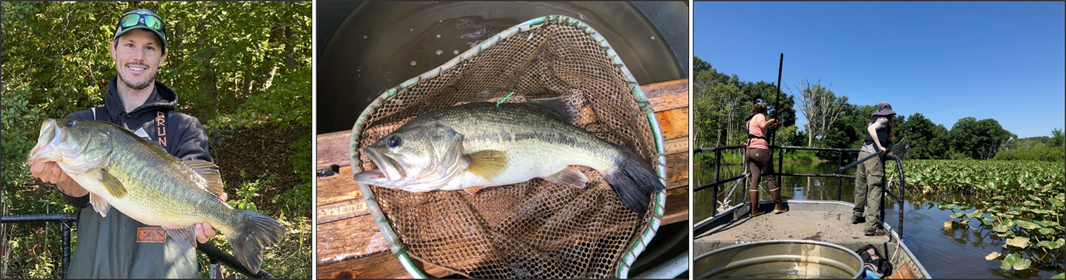
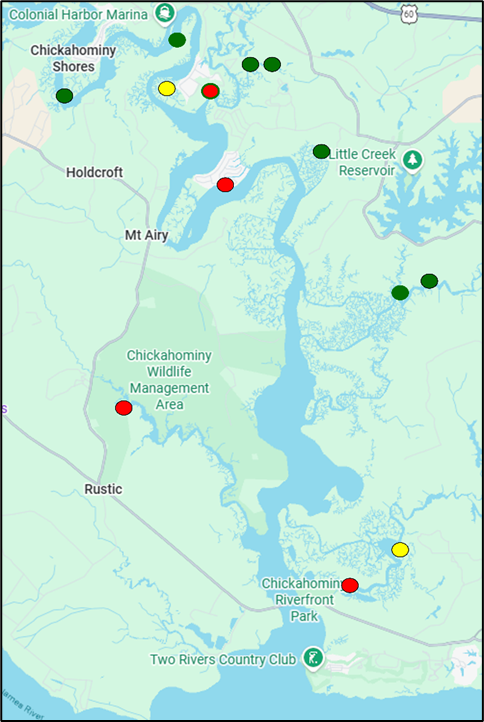
Carte d’un sous-ensemble de sites d’échantillonnage de bass à l’automne 2026. Les sites verts affichaient les taux de capture les plus élevés, les rouges les plus faibles, les intermédiaires jaunes.
Les populations de black-bass dans les rivières James et Chickahominy restent fortes. Un printemps frais et pluvieux a maintenu la température de l’eau plus basse que la moyenne en vue de l’été, suivi d’un automne très sec et chaud. Les flux intenses et les nombreuses tempêtes du printemps et du début de l’été ont pu impacter le recrutement, entraînant une diminution de l’abondance juvénile (Figure 2). Bien que ce ne soit pas idéal, il est normal d’avoir des années bonnes et des mauvaises années : un mauvais recrutement en 2025 n’est pas censé avoir un impact négatif sur la santé de la population à l’avenir. Un automne sec signifiait que la salinité était supérieure à la moyenne dans la James River au-dessus de Weyanoke Point et de la rivière Chickahominy jusqu’à la Route – y compris les affluents. Une salinité plus élevée poussait les bars plus en amont à chercher de l’eau douce. En conséquence, les biologistes du DWR ont principalement observé des bars plus petits dans les habitats en aval et n’ont vu que des bars plus gros plus haut dans les systèmes (Figure 1). Dans le Chickahominy, 1-3 lb. Le bar dominait la prise sur les sites en aval, tant dans le cours principal que dans les affluents ; tandis que les achigans plus gros dans le 5-9 lb. la chaîne était prise en hauteur dans les affluents et au-dessus de la Route. Il y a beaucoup d’opportunités pour attraper 5-6 lb. Avec le potentiel de capturer des poissons plus gros de plus de 8 livres. Dans la James, les taux de capture les plus élevés et les plus grands achigans ont été capturés dans les ruisseaux Herring et Queens. Les petits ruisseaux, comme Queens, Flowerdew Hundred et Kittewan, offrent un habitat abondant et de haute qualité. Malgré leurs chenaux plus petits, ils soutiennent des populations saines et offrent des opportunités de capturer des bars trophées.
Dans les rivières à marée, la météo a un impact considérable sur le comportement des poissons, en raison de sa relation avec la salinité. Les prévisions à long terme pour la côte de Virginia annoncent des températures plus chaudes et moins de pluie du printemps au début de l’automne 2026. À l’approche du printemps, les bars sont plus souvent trouvés le long de l’herbe et des bords de spatterdock dans 2à3 pieds d’eau alors qu’ils se préparent à frayer. Lorsque la température de l’eau augmente, les poissons se déplacent vers les habitats rivaux avec des structures ligneuses près des chutes de chenaux. Les arbres tombés, les troncs et souches submergés, ainsi que les embouchures de ruisseaux sont de bons endroits pour pêcher les poissons plus gros. Si vous n’avez pas de chance dans vos endroits habituels, la salinité pourrait être la cause. S’il n’a pas plu depuis un moment, essayez de remonter le cours d’eau vers des eaux plus douces — surtout si vous pouvez suivre une marée descendante.
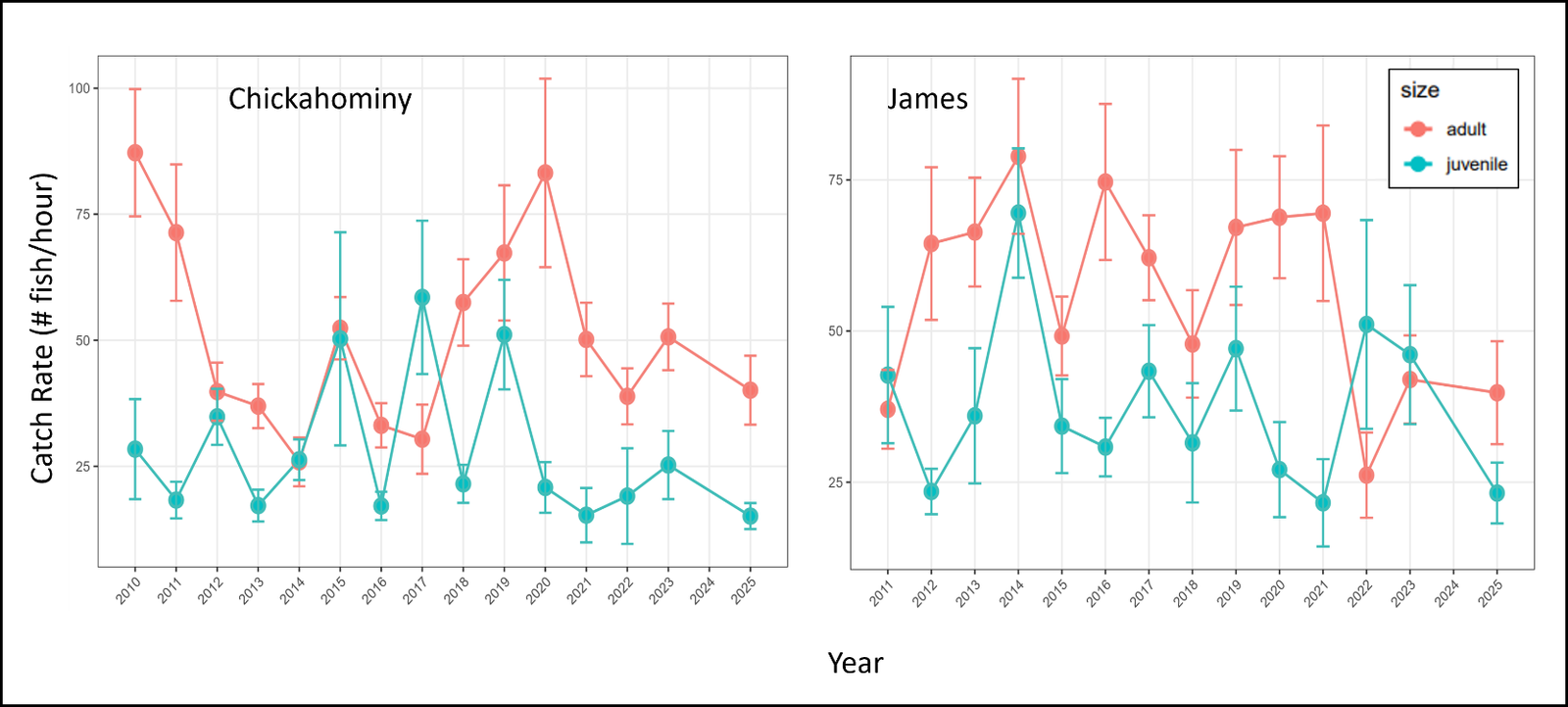
Figure 2. Taux de capture de blackbass adulte (rouge) et juvénile (bleu) dans les rivières James et Chickahominy depuis 2010. Le taux de capture est calculé comme le nombre de poissons prélevés par heure d’échantillonnage. L’échantillonnage est réalisé chaque automne par pêche électrique en bateau. Le plan d’échantillonnage du DWR a été modifié en 2021 afin d’évaluer mieux la santé de la population de bars à long terme. Des changements significatifs dans les taux de capture à partir de 2021 reflètent ce changement, et non un changement soudain de la santé de la population.
Contrôle & Gestion
Rivière York
L’échantillonnage de l’automne 2025 dans les rivières Pamunkey et Mattaponi a été limité en raison d’une combinaison de salinité élevée sur les sites d’échantillonnage en aval et d’observations d’esturgeons atlantiques sur des sites d’échantillonnage en amont. Les deux rivières seront plus échantillonnées à l’automne 2026 et opportunément au printemps/début de l’été.
Espèces envahissantes
Le bar de l’Alabama continue d’être une menace importante pour le blackbass à grande bouche dans les rivières James et Chickahominy ; ainsi que des achigans à petite bouche dans la rivière James au-dessus de la ligne de chute. Dans les États où l’Alabama a été introduit, il a surpassé le bar à grande bouche et s’est hybridé avec le black-bass, provoquant un déclin des deux populations. Dans la région des eaux de marée, des bars d’Alabama ont été trouvés dans le réservoir de Diascund ainsi que dans les rivières Chickahominy et James. Le bar d’Alabama ressemble au black bass mais peut être identifié par quelques caractéristiques clés. Le bar d’Alabama a des mâchoires plus petites qui s’étendent jusqu’au milieu de l’œil, tandis que le black bass à grande bouche a des mâchoires qui dépassent l’œil. Les achigans d’Alabama ont également une tache de dent sur la langue et une coloration distincte. Les pêcheurs qui pensent avoir attrapé un bar de l’Alabama sont encouragés à prendre une photo et un petit découpage de la nageoire pelvienne (conservé dans une enveloppe sèche) et à contacter le DWR pour obtenir des informations sur l’endroit où le poisson a été capturé. DWR prélève régulièrement des échantillons pour stopper la propagation de ces envahisseurs, mais l’aide des pêcheurs est cruciale.
Poisson-chat bleu
Les rivières de marée de Virginia continuent d’offrir d’excellentes opportunités de pêche au poisson-chat bleu, malgré l’évolution de la taille des populations. À mesure que les populations de poisson-chat bleu augmentaient et que les poissons devaient se concurrencer pour la nourriture, le nombre de petits poissons augmentait par rapport aux gros. Cela a entraîné une diminution du nombre de poissons trophées au cours des 10 dernières années. Après le pic d’abondance du poisson-chat bleu vers 2011, la population a progressivement diminué et s’est orientée vers des poissons plus petits. Bien que cela ait rendu plus difficile la recherche de poissons de plus de 50 livres, il existe encore des opportunités de capturer de gros poissons dans des zones où la pression de la pêche commerciale et récréative est moindre. Les affluents de York et la rivière Rappahannock abritent des poissons-chats de taille trophée, bien qu’ils ne soient pas aussi constants que les rivières James et Chickahominy.
Les poissons-chats bleus commencent leur migration de frai au printemps lorsque la température de l’eau atteint entre 46 et 50°F. La pêche autour de l’embouchure des ruisseaux est une bonne option lorsque ces poissons sont en mouvement. Lorsque la température de l’eau augmente après la frai, elles forment des agrégations denses en eau profonde, il faut donc rechercher des trous profonds et des déversements, de préférence avec des structures dans les coudes des ruisseaux et la rivière principale.
Avis
La Virginia Marine Resources Commission régule la pêche commerciale du poisson-chat bleu (VMRC). Toute question concernant la pêche commerciale doit être adressée au VMRC, les coordonnées sont disponibles à www.mrc.virginia.gov.
Le Département de la Santé de Virginia a émis des avis de consommation pour le poisson-chat bleu dans les rivières à marée. Dans les rivières York et Rappahannock et leurs affluents, il est conseillé de limiter la consommation de poisson-chat bleu à 2 repas par mois. Dans la rivière James et ses affluents, il est conseillé de limiter la consommation à 2 repas par mois et de ne pas consommer de poisson-chat bleu plus grand que 32». Plus d’informations sur les avis de consommation de poisson dans les eaux de Virginia sont disponibles à www.vdh.virginia.gov/environmental-health/public-health-toxicology/fish-consumption-advisory.
Contrôle & Gestion
Les poissons-chats bleus ne sont pas originaires de Virginia et ont été empoissonnés dans les eaux de marée dès les années 1970. Leur tolérance à la salinité et leur alimentation opportuniste les ont aidés à se répandre dans les bassins versants de la baie de Chesapeake. Des projets de recherche en cours visent à évaluer les mouvements et l’abondance et à étudier les impacts sur les poissons indigènes de Virginia.
Surveillance
DWR échantillonne le poisson-chat bleu dans les rivières James, Chickahominy, York, Rappahannock et Piankatank selon un calendrier biannuel et tournant, utilisant la pêche électrique en bateau à basse fréquence. En 2025, les rivières Rappahannock, Pamunkey et Mattaponi ont été échantillonnées ; les rivières James, Chickahominy et Piankatank seront échantillonnées en 2026. Ces données servent à détecter les tendances des populations de poisson-chat bleu, à surveiller la structure de taille et à contribuer à la recherche dans toute la région.
Étude du mouvement
À l’automne 2021, le DWR a lancé une étude de suivi visant à identifier les schémas saisonniers de déplacement et les zones d’agrégation des poissons-chats bleus dans le système de la James River. Les biologistes du DWR ont implanté chirurgicalement des étiquettes acoustiques dans 90 poisson-chat bleu à ce jour. Les poissons-chats bleus marqués ont également reçu une étiquette rouge à fléchettes afin que les pêcheurs puissent identifier les poissons faisant partie de l’étude. Si vous êtes capturé et gardé, veuillez appeler DWR au numéro indiqué sur l’étiquette (804-829-6580) pour signaler la prise et retourner l’étiquette acoustique afin qu’elle puisse être placée dans un autre poisson.
La zone entre Tar Bay et Weyanoke Point a constamment affiché la plus forte densité de poisson-chat bleu toutes saisons. La plupart des poissons marqués (plage de taille 16 à 45 pouces) passaient les mois d’hiver dans les environs de Weyanoke et Coggins Points, en amont ou près de l’embouchure du ruisseau Upper Chippokes, plus en aval. Par temps sec, la salinité augmente plus en amont dans les rivières et affluents. Bien que le poisson-chat bleu ait une tolérance limitée à la salinité, il préfère s’agréger en eau douce. Les prévisions à long terme pour la côte de Virginia annoncent un été et un automne secs – si vous n’avez pas de chance dans vos endroits préférés, essayez de remonter vers des eaux plus douces.
Si vous avez des questions ou des préoccupations concernant ce projet, ou simplement souhaitez en savoir plus sur la gestion du poisson-chat bleu du DWR, veuillez nous contacter au numéro ci-dessous.
Prévisions de pêche par rivière
Rivière Potomac à marée
Les affluents de la rivière Potomac de Virginia, au sud de Washington D.C. jusqu’au comté de Stafford, devraient offrir une excellente pêche au bar à grande bouche en 2026. Les taux de capture de l’achigan adulte lors des enquêtes de pêche électronique menées en avril et mai 2025 étaient les plus élevés documentés depuis le début des enquêtes standardisées il y a 21 ans. La reproduction des achigans au cours de la dernière décennie a été au-dessus de la moyenne, avec de bonnes années de recrutement largement supérieures aux mauvaises années. Cherchez des poissons sur de gros débris ligneux à marée haute avant l’apparition de la végétation et sur les bords des lits de Spatterdock plus tard au printemps. Les spatterdocks flats à l’extérieur des embouchures de ruisseaux alimentant le bas Occoquan (baie de Belmont) abritent un nombre impressionnant de bars en avril et mai. La pêche à la tête de serpent devrait être moyenne à Aquia mais inférieure à la moyenne dans de nombreux autres ruisseaux du nord en dessous de DC, car les chiffres semblent s’être stabilisés à une abondance plus faible. Les têtes de serpent sont souvent plus faciles à localiser tôt dans la saison, avant l’apparition de la végétation aquatique. Ciblez la végétation inondée des zones humides, le bois naturel et les quais lors des marées de montée avant que le spatterdock n’émerge, puis les bords du spatterdock à marée basse avant l’émergence du SAV. Une fois le SAV établi, on peut trouver des têtes de serpent dans n’importe quelle parcelle, en particulier l’Hydrilla.
Rivière Rappahannock à marée
(Au-dessus de Fredericksburg)
La pêche au bar à petite bouche sur la partie supérieure des rivières Rappahannock et Rapidan (au-dessus de Fredericksburg) en 2026 devrait se dérouler comme l’an dernier. Comme la plupart des rivières de l’est et du centre de la Virginia, les hautes eaux à la fin du printemps récemment ont entraîné un faible succès de frai, et par conséquent l’abondance du bar à petite bouche a diminué depuis 2020. La population de bar à grande bouche est en expansion, et leur nombre est fort sur les tronçons plus lents, surtout lorsque la SAV est présente. On peut trouver des têtes de serpent dans ces mêmes habitats plus lents et végétalisés ; Donc les appâts sans mauvaises herbes (plastiques souples au printemps, et en surface en été) sont un bon choix. Attendez-vous à voir des têtes de serpent s’empiler sous le barrage de Rapidan Mill de la mi-avril jusqu’au début mai, avant qu’ils ne reculent de leur migration avant frai. Les rivières sont remplies de poissons-chats de la taille idéale pour manger, qui colonisent le bassin versant supérieur depuis la chute du barrage Embrey. La perche jaune, la perche blanche et le bar rayé peuvent désormais aussi être trouvés bien au-dessus de Fredericksburg, les barrières de migration ayant disparu.
(Fredericksburg à Port Royal)
La pêche au bar à grande bouche et au Snakehead du Nord devrait être excellente en 2026 dans la marée de Rappahannock entre Fredericksburg et Port Royal. Cette zone de la rivière a connu une abondance de végétation aquatique submergée (SAV) ces dernières années, ce qui a probablement alimenté plusieurs frayères réussies et entraîné des taux de capture supérieurs à la moyenne de bass et de snakeheads, qui semblent susceptibles de se poursuivre. Les taux de capture d’achigans adultes dans cinq des six dernières années ont été les plus élevés enregistrés en un quart de siècle d’enquêtes, et la production juvénile a de nouveau été supérieure à la moyenne en 2025, s’ajoutant à sept années solides de recrutement au cours des neuf dernières saisons. Un record d’apparition a été enregistré en 2023. Ciblez les bars dans les embouchures des ruisseaux lors des marées sortantes et, bien sûr, les bords (et même à l’intérieur) des tapis épais de végétation. Le bar peut également être trouvé dans de gros débris ligneux près des bords de chenaux, surtout à marée basse. L’abondance de la snakehead était d’environ 2024 après avoir diminué pendant deux ans après avoir atteint un pic en 2022, mais les taux de capture restaient plus élevés ici que dans la plupart des affluents de la rivière Potomac à marée supérieure. Cherchez des serpents du côté des berges (à l’intérieur) des bandes de végétation dans des eaux très peu profondes (parfois à quelques centimètres de profondeur).
(En dessous de Port Royal)
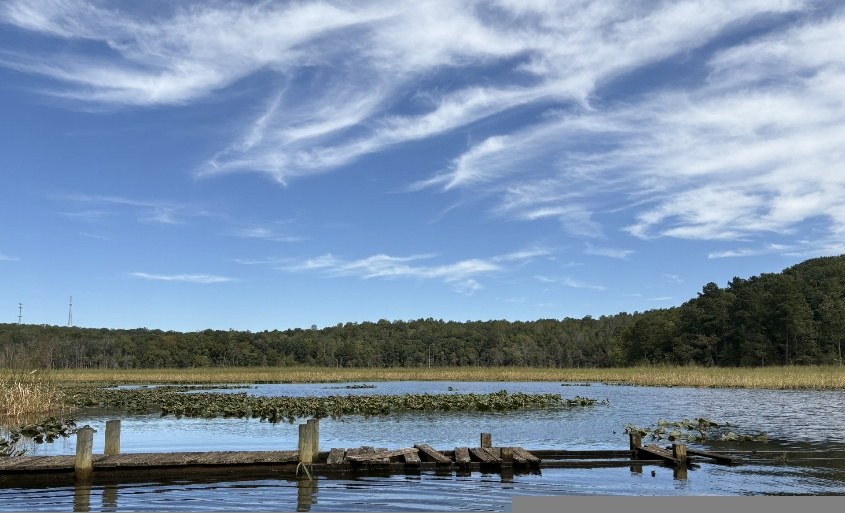
Les affluents de la rivière Tidal Rappahannock, de Port Royal jusqu’à Totuskey Creek, offrent une richesse d’habitats pour une grande variété d’espèces de poissons. La rivière Rappahannock a connu des niveaux de salinité élevés en octobre 2025 en raison du temps sec prolongé qui a frappé la région. Les sites de basse gamme dans les ruisseaux Occupacia, Totuskey et Cat Point n’ont pas été échantillonnés en raison des niveaux élevés de salinité. L’enquête 2025 consistait en 25 sites de rivage afin d’obtenir une évaluation représentative des différentes populations de poissons. Les enquêtes de pêche électronique de l’automne 2025 collecté 37 espèces de poissons pour un total de 1797 poissons. Cette capture totale a montré une baisse de l’action par rapport à l’enquête 2024 qui a capturé 2,836 poissons de 33 espèce.
Les pêcheurs ciblant le bar à grande bouche à l’est de Port Royal trouveront une abondance raisonnable de poissons dans et autour des tapis denses de la croissance des hydrillas. Parmi les meilleurs sites pour le bar en 2025 figuraient la rive nord juste à l’ouest de Wilmont Landing, les plaines hydrilla à l’est de Port Royal, et la rive nord à l’ouest de Gingoteague Creek. Les champs de spatterdock sur la rive sud, en face de Wilmont Boat Landing, sont toujours un endroit attrayant pour trouver du bar. Les 2025 relevés ont permis d’obtenir un total combiné de 196 achigans à grande bouche pour un taux de capture de 28 bar par heure. Ce taux de capture a montré une augmentation à partir de 2024 (n = 174; 24 bar par h.). L’étude 2025 n’a pas permis de produire beaucoup de basses de plus grande taille avec un poids maximal de 5.2 livres. Les années d’enquête de 2022 et 2023 révélèrent un recrutement constant de bars avec une abondance de poissons juvéniles récoltés. La frai 2024 n’a pas été aussi forte avec une baisse notable du YOY (Young of Year). D’après l’analyse initiale, le frai de 2025 semblait en bon état avec une forte proportion de poissons dans la fourchette de 4à6pouces.
La rivière Rappahannock a produit des captures meilleures que la normale de poissons-chats bleus dans la fourchette de 30à50livres, avec des rapports faisant surface de quelques poissons encore plus gros. L’enquête 2024 a trouvé des poissons-chats bleus très impressionnants dans la gamme de 40à60livres, tenant fermement la couverture du rivage dans 2 pieds d’eau. L’enquête 2025 n’a pas réussi à trouver le poisson-chat bleu plus grand. La pêche électrique à haute fréquence n’est pas la meilleure technique d’échantillonnage pour collecter le poisson-chat. La collection limitée de poissons-chats avait une taille moyenne de 20 pouces. La population de poissons-chats bleus devrait encore fournir une abondance suffisante de poissons de 2à4livres si les pêcheurs cherchent à trouver un bon repas. Parmi les meilleurs endroits à essayer sont les trous plus profonds dans quelques grands affluents où les poissons-chats s’accumulent généralement.
La rivière Tidal Rappahannock reste une destination prisée des pêcheurs souhaitant participer à l’action de la course de la perche jaune chaque printemps. La plupart de cette activité se trouve entre la fin février et les premières semaines de mars. Certains des affluents inférieurs dans et autour de Tappahannock sont des destinations populaires. Les pêcheurs prêts à affronter le froid peuvent trouver ces poissons empilés dans certaines poches des ruisseaux durant les mois de décembre et janvier si la couverture de glace ne constitue pas un obstacle. L’enquête 2025 a trouvé plusieurs classes d’années de juvéniles avec une poignée de poissons 10». Le bateau de pêche électrique n’a croisé aucun poisson 1113» lors de l’enquête d’automne. La plupart des plus gros poissons sont rencontrés lors de la migration printanière lorsque les conditions rapprochent les poissons des eaux peu profondes. Les pêcheurs sont rappelés que la limite minimale de taille pour la perche jaune est 9» pour toutes les rivières tidales de Virginia de la baie de Chesapeake en aval des lignes de chute.
Des relevés ont trouvé des poches dispersées de Bowfin en bonne santé dans certains affluents, mais l’abondance globale a montré un déclin de 2025 avec une capture limitée de 15 poissons (CPUE = 22 poisson/h). La population de Snakehead du Nord, basée sur les récentes collectes de DWR, a montré une baisse du taux de capture, passant de 7 poissons/heure en 2023 à 2.6 poisson/heure en 2024. L’enquête 2025 a collecté 29 Snakehead du Nord pour un taux de capture de 4.2 poisson/heure. De nombreuses zones de la rivière ont connu un important afflux d’activités de pêche à l’arc, ce qui a mis à rude épreuve les populations de Snakehead du Nord et de Bowfin indigène. Les enquêtes 2025 ont montré une présence réduite de Poisson-Soleil Rouge de plus grande taille par rapport aux années précédentes. Les pêcheurs sont encouragés à limiter leur récolte de Shellcracker pendant la fraie dans l’espoir de permettre à leur population de rebondir à l’avenir.
Les perches blanches ont historiquement été abondantes dans la rivière Rappahannock. Les 2025 enquêtes de pêche électronique ont donné un total de 154 perches blanches pour un CPUE de 22 poissons/h, ce qui a montré une baisse par rapport à l’enquête 2024 (CPUE = 34 poissons/h). Les pêcheurs devront peut-être désherber de nombreux petits poissons dans la fourchette de 5à7pouces pour trouver des poissons de plus grande taille pour la poêle. La perche blanche est l’un des poissons les plus savoureux du système fluvial. Les pêcheurs de perchaudes blanches pourraient aussi s’intégrer à l’action du Black Crappie.
Certaines poches de la rivière peuvent contenir de bons crappies noirs dans la fourchette de 12à14pouces. De grands bancs de crappie n’ont pas été détectés lors des enquêtes d’automne. Certains arbres abattus avec une profondeur d’eau suffisante à marée basse donneront une douzaine de poissons de taille moyenne. L’enquête 2025 a révélé une augmentation de l’abondance du crappy noir, la majorité des poissons étant en excellente condition physique.
Rivière Upper Piankatank
La rivière Piankatank supérieure offre un lieu pittoresque pour les pêcheurs. La rampe publique la plus proche se trouve assez loin en aval, au débarcadère DWR Deep Point. À plusieurs kilomètres en amont de la rampe de mise à l’eau, les pêcheurs trouveront une abondance d’habitats marécageux le long des rivages ainsi que des cyprès. L’étude automnale de la haute rivière Piankatank a révélé une forte richesse en espèces avec 20 espèces de poissons collectées. Cinq sites de pêche électrique ont été échantillonnés le 9octobre 2025, vers l’extrémité supérieure de la rivière Piankatank, où elle se fond dans la Dragon Run. Le coin de salinité d’un autre automne sec a rendu impossible l’échantillonnage des sites de bas niveau. L’enquête 2025 a constaté une diminution de l’abondance du bar à grande bouche avec 24 poissons collectés (CPUE = 17.3 poisson/h). Ce taux de capture ne correspondait pas à l’enquête 2024 (n = 59; CPUE = 43 poissons/h.). Le recrutement des poissons juvéniles par le bar était faible, avec seulement 5 poissons de moins de 11 pouces. La basse de taille moyenne mesurait 12.72 pouces avec un poids de 1.29 Des livres. Le plus grand bar pesait 4.38 Livres, qui étaient similaires à 2024 (poids maximal = 4.35 lbs.). Les pêcheurs auront du mal à trouver un ou plusieurs achigans de plus de 5 livres dans ce tronçon de la rivière, mais ils devraient trouver une présence décente de 1à2.5-livre Bass.
The catch of Bowfin reached record potential in 2025 with the collection of 393 Bowfin, up from the 202 collected in 2024. The Bowfin population within the Piankatank River is one of the strongest within Virginia. The Bowfin population showed a decline in average weight, 2.1 pounds, down from 2024 (mean wt. = 2.6 pounds). Very few Bowfin will crack the 5-pound mark. The largest Bowfin weighed 5.78 pounds. The fall survey found one Northern Snakehead that measured 28.54 inches with a weight of 6.4 pounds. Past surveys have yielded a limited number of Northern Snakehead, so this was no huge surprise. The Redear Sunfish population has shown some decent potential with 9 to 10” fish present. The Black Crappie population failed to excite in 2025 with only 6 fish collected. Three of these fish were in the 10–11-inch range. Upper Piankatank River has a decent abundance of White Perch with most fish running in the 7 to 9” range. The largest White Perch of 2025 was 9.6 inches long. Larger-sized White Perch in the 10 to 12” range have been reported by anglers fishing the more brackish water of the middle river. Anglers might encounter some decent Chain Pickerel in the tannin-stained waters of Dragon Run. The fall survey failed to catch any pickerel of substantial size with the average size of 9”. Past surveys have shown forage base limitations in areas of lower Dragon Run. These limitations might find predator fish more active and susceptible to striking properly placed lures and baits. Past surveys have found the lower end sites to yield an abundance of juvenile Spot and large schools of Eastern Silvery Minnows. This was not the case in 2025, as the various forage species were in short supply. Only three juvenile Striped Bass were collected during the survey. The high frequency electrofishing failed to find a single Blue Catfish in the fall of 2025. Commercial activity in this area of the river is most likely harvesting a fair number of the Blue Catfish.
Pour plus d’informations sur les rivières à marée de Virginia, contactez le bureau régional concerné.